4. Essential Golf Rules You Should Know!
Teeing Area
What is a teeing area?
The teeing area is the place where you hit your first shot. When you go to the area, you'll see markers like the one shown in the diagram. It's common for women to start with the ladies' tee markers and men with the regular tee markers. Back tee markers are for advanced players.
After choosing your tee marker on the very first hole, you must use the same colored tee marker until the final hole. Using a different colored tee marker will result in a two-stroke penalty, so choose your tee marker carefully.
Typical tee markers
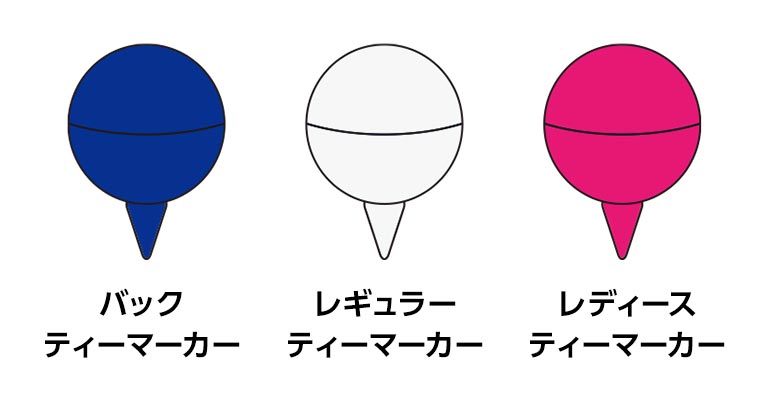
This is just an image. Other colors may be available depending on the course.
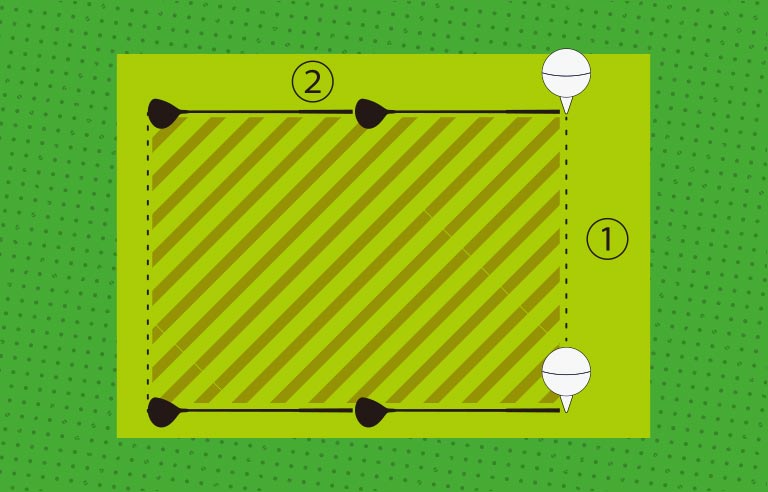
Regarding the definition of the teeing area
As shown in the diagram, the tee markers are set up in pairs. First, draw a line connecting the pair of tee markers (①), and the square area enclosed by a length of two club lengths (driver) from there (②) (shaded area) is the teeing area. For the first shot, set the ball within this shaded area and hit it.
Hitting the ball outside this area will result in a two-stroke penalty.
Possible situations and rules on the teeing area
● The teeing area was leveled before hitting the ball.
→ No penalty
Since your tee shot is before play begins, you can smooth it out without penalty. However, be aware that if you hit your second shot or later from the teeing area, you will incur a two-stroke penalty!
● The ball fell off the tee before the swing.
→ No penalty
Since play hasn't started yet, you can tee up again and hit your first shot without any penalty strokes.
● I mishit a shot and the ball landed near the tee marker... so I moved the tee marker because it was in the way.
→ No penalty
Tee markers are fixed objects for the first shot, but can be moved as obstacles from the second shot onward.
● I hit the ball in the wrong order.
→ No penalty
The order of play is usually determined by drawing lots for the first hole. After that, players play in order of their score from the previous hole, starting with the one with the best (lowest) score. There is no penalty for not following the rules, but be careful as it may be considered bad manners.
General Area Chapter
The general area is the entire hole excluding the teeing area, penalty area, bunker, and putting green.
● I confirmed that it was my ball during the round.
→ No penalty
You can check the ball's position by marking it.
● The cracked ball was replaced with another ball.
→ No penalty
If the damage occurred during play, you can inform your playing partners and have the item replaced.
● The batted ball hit a fellow competitor's personal belongings.
→ No penalty
There is no penalty if the ball hits a fellow competitor's bag or other personal belongings; play continues from where the ball landed.
● The club I swung hit a tree and broke a branch.
→ No penalty
If the result is an improvement (intentional) in the swing area, there is a two-stroke penalty; if there is no improvement, there is no penalty.
● The dropped ball hit my foot.
→ No penalty
If the dropped ball hits your foot, you must drop it again without penalty.
●I was practicing my swing and touched the ball, and it rolled away.
→1 penalty stroke
This incurs a one-stroke penalty, and the ball must be returned to its original position before play begins. However, if the ball lands within the teeing area after a missed tee shot, there is no penalty, and the player can re-hit.
●I was looking for my ball and accidentally moved my own ball.
→ No penalty
If you move the ball intentionally, you will incur a one-stroke penalty and must return it to its original position before resuming play.
● I moved the ball when I was setting up.
→1 penalty stroke
You incur a one-stroke penalty, return the ball to its original position, and hit again.
● He stepped on the back of the ball before hitting it.
→2 penalty strokes
This will improve your swing range and will result in a 2-stroke penalty.
●I accidentally hit someone else's ball.
→2 penalty strokes
Two penalty strokes are added, and you hit your correct ball.
There is no penalty for the player who is hit (the game is restarted from the original spot).
Penalty Area
A penalty area is what was formerly called a water hazard, referring to ponds or the sea on the course. These areas are marked with yellow stakes. Another type is called a lateral water hazard, which refers to a water hazard that runs parallel to the hole like a river. These areas are marked with red stakes.
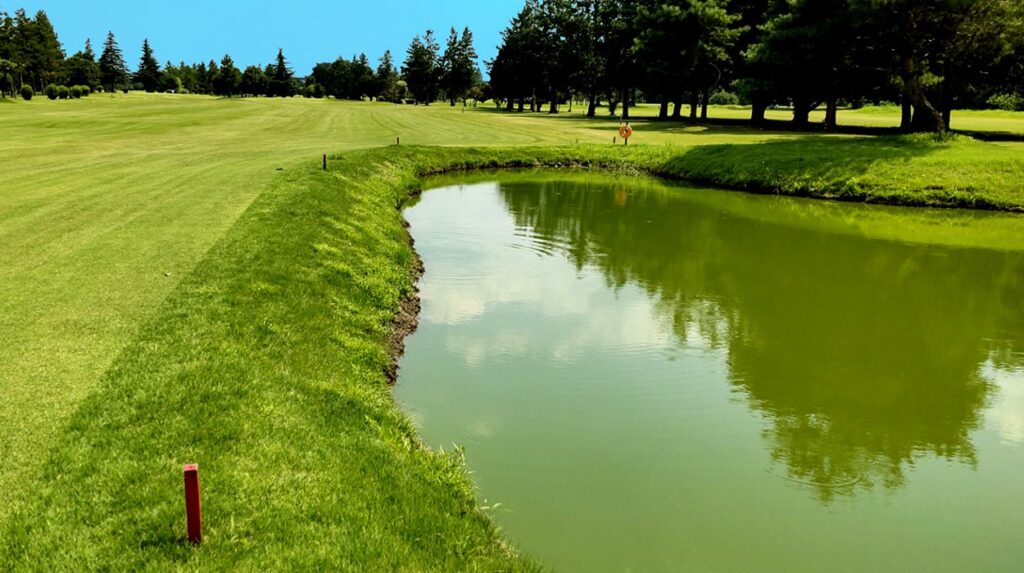
How to deal with it
In both water hazards and lateral water hazards, if the ball is in a "hittable condition," you can hit it without penalty.
If you are in a situation where you cannot hit the ball (which is the majority of cases), you can replay the game under the following conditions:
[Former Water Hazard (Yellow Stakes)]
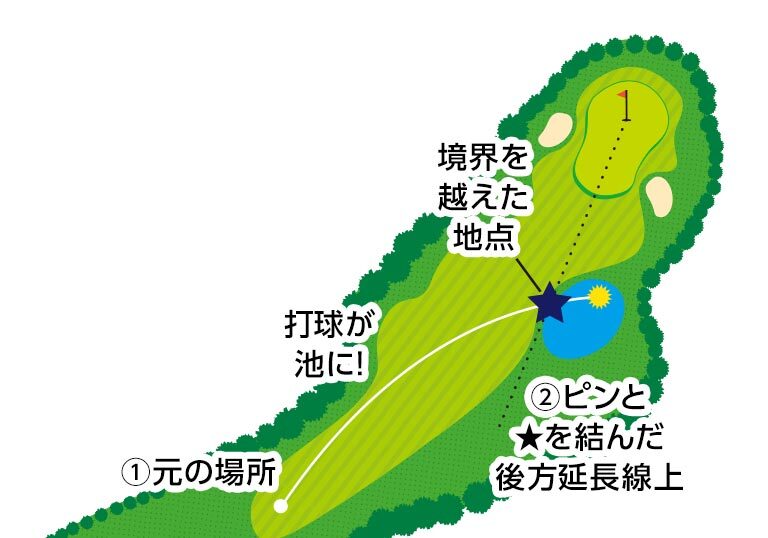
① Take a one-stroke penalty and return to the original spot to hit again.
② With a one-stroke penalty, drop the ball on the extension of the line connecting the point where the ball crossed the boundary (★ in the diagram) and the pin, and play again.
There are no restrictions on the line extending backward as long as it's within the hole, but the further back you go, the longer the remaining distance will be, so find a suitable spot.
[Former Lateral Water Hazard (Red Stake)]
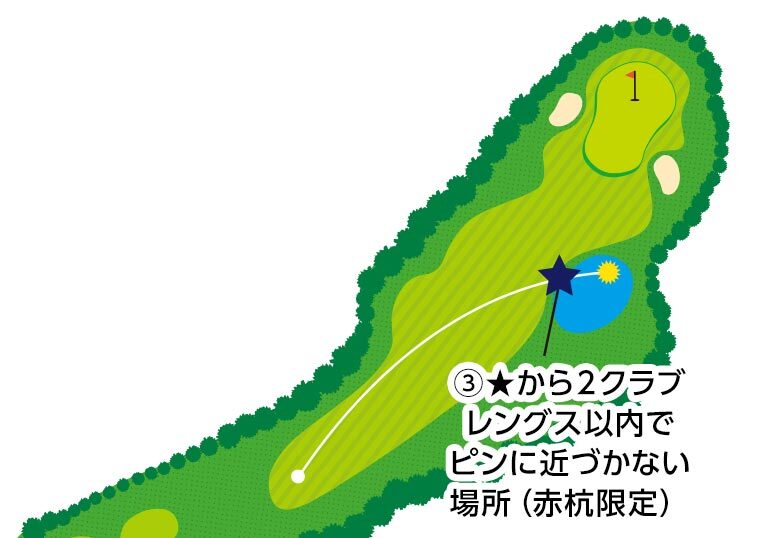
The same procedure applies as with the yellow stakes, but there is one additional measure.
③ With a one-stroke penalty, drop the ball within two club lengths of the point where it crossed the boundary (★ in the diagram) and play again in a location that is "not closer to the pin".
Method ③ is only applicable to the area marked with red stakes, so be careful, as using it in the area marked with yellow stakes will result in an additional 2-stroke penalty for playing from the wrong location.
In golf, the fundamental principle is to "play the ball as it lies," and if this is not possible, you can move the ball and pay a penalty (with some exceptions).
Bunker Edition
The sand traps known as "bunkers" are scattered throughout the golf course. They're often placed in tricky locations, causing considerable trouble for golfers, but there are a few rules to follow when it comes to bunkers as well.
A careless mistake could result in a major penalty...
● Removed natural objects (loose impediments) present on the golf course, such as fallen leaves, branches, pebbles, clumps of soil, and insects, from the bunkers.
→ No penalty
Previously, loose impediments in bunkers could not be removed, but the 2019 rule change made it possible to remove them. If you think they are interfering with play, remove them before playing.
However, trees and plants with roots, and things that are fixed in place are excluded.
● I took practice swings in the bunker and sand got on my club.
→2 penalty strokes
Testing the condition of the bunker sand will result in a penalty. Please be careful not to touch the sand from the moment you enter the bunker until just before you hit the ball.
●If you're not good at bunkers, you can get out of them with a 2-stroke penalty!
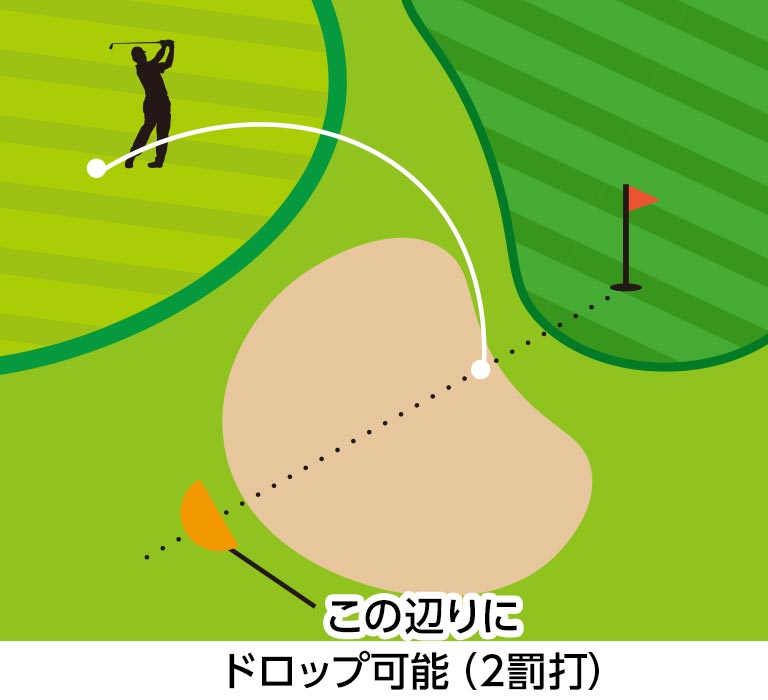
Until now, the general rule was that if your ball landed in a bunker, you had to hit it from there, which often resulted in multiple shots and dropped your score. But now there's a new rule! You can declare the ball unplayable and drop it "outside the bunker" on the extension of the line connecting the pin and the ball (for a 2-stroke penalty).
If your second shot lands in a bunker, should you hit your third shot from the bunker, or take a two-stroke penalty and hit your fifth shot from the grass? Which is better depends on the situation. Try to use the rules wisely.
Putting Green Edition
The putting green is often called the "highlight of the golf course." There are a few rules you should know about this as well.
● If the ball moves on the green due to the wind while you are waiting behind it before hitting it.
→ No penalty
Play will resume as soon as the ball comes to a halt in that position.
●When you are taking practice swings before putting, and the ball moves on the green due to the wind.
→ No penalty
Play will resume as soon as the ball comes to a halt in that position.
●When you are addressing the ball, if the ball has moved on the green due to the wind.
→ No penalty
●When you have set up and are about to hit the ball, and the ball has moved on the green due to the wind.
→ No penalty
●I putted without removing the pin and it went in.
→ No penalty
Previously, you had to remove the pin before putting once the ball was on the green, but a rule change in 2019 allowed you to putt with the pin in. This rule is very useful to remember, as it can shorten playing time.
● I picked up the ball without marking it.
→1 penalty stroke
On the green, you must always mark your ball before picking it up, unless it goes into the cup.
About Mark
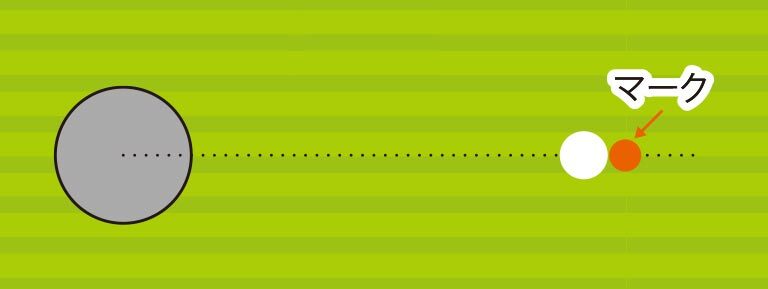
You can pick up the ball after marking the spot "just behind the ball" on the line extending backward from the cup and the ball (using a coin or marker). Also, be sure to remove the marker after returning the ball to its original position.
Application of Mark
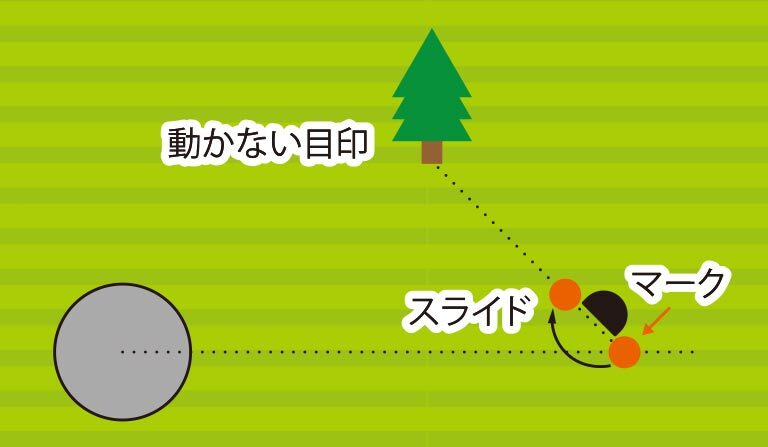
If your marker is obstructing a player hitting from behind, find a stationary marker and slide your marker one putter head length along the line connecting the marker and the stationary marker to avoid obstruction. Remember to return your marker to its original position after the other player has finished their shot.
Others
● OB (Out of Bounds)
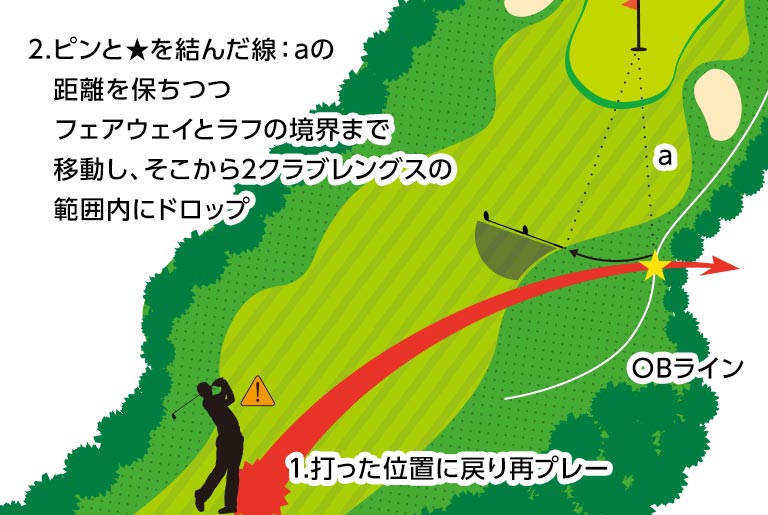
Each course is not playable everywhere; there are areas where play is prohibited, commonly known as "OB" (Out of Bounds). If your ball lands in an OB area, you must choose one of the following options to replay the ball.
- You take a one-stroke penalty and return to the spot where you hit the out-of-bounds shot to replay.
- With a 2-stroke penalty, move to the point where the ball crossed the out-of-bounds line with the pin as the axis, maintaining distance 'a', without getting closer to the pin, to the boundary between the fairway and the rough, drop the ball within 2 club lengths from there, and replay.
Regarding point 2, please note that this is a local rule and is unlikely to be recognized in competitions.
● Unplayable
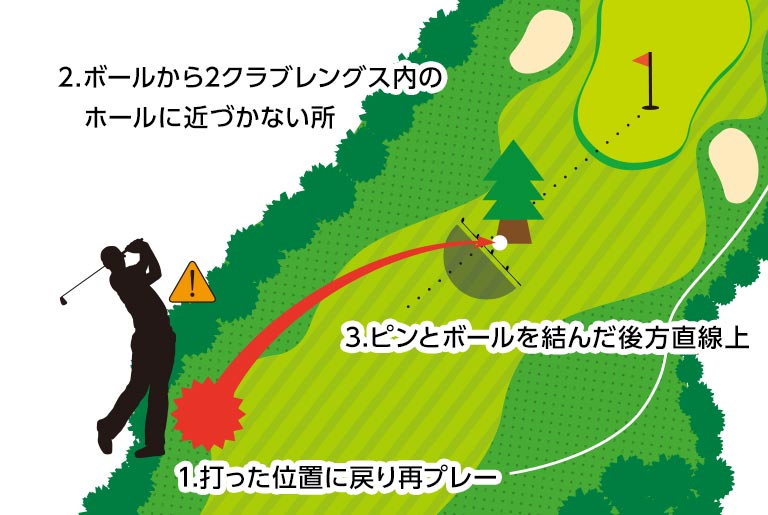
Unplayable refers to a situation where the ball cannot be played (the ball cannot be hit). You declare this when the ball stops at the base of a tree, in bushes, etc., and then select from the options below.
- One penalty stroke, return to the original position and hit again.
- Take a one-stroke penalty and drop the ball within two club lengths of the ball, no closer to the pin.
- The penalty is one stroke, and the ball will be dropped in a straight line behind the line connecting the pin and the ball.
If the ball lands in a bunker, shots 2 and 3 must be dropped within the bunker. If you wish to drop the ball outside the bunker, you can do so with a 2-stroke penalty.
● About Drop
If you miss a shot, you'll have to pay a penalty and drop the ball in a designated spot. There's a specific way to drop the ball: you must drop it from knee height. Be careful, because if you do it wrong, you'll have to drop it again.
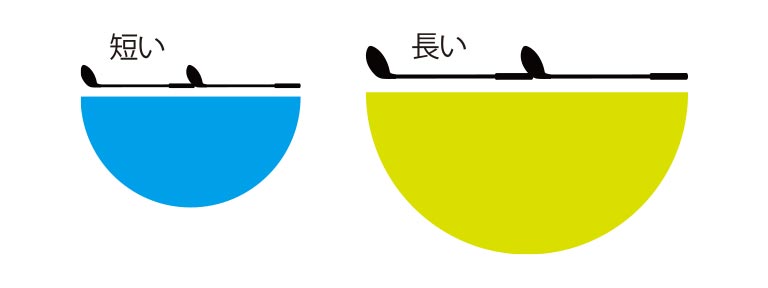
● About club length
The rules mention "within X club lengths," which might make you wonder, "Which club does 'club length' refer to?" Actually, any club will do (as long as it's your own club). Therefore, measure using the longest club you own.